Fastest Trains in India in 2026 (Full List)
Which Indian trains are actually fastest end to end, ranked by real average speed rather than headline top-speed claims that rarely hold for a full journey.
 TrainLiveStatus Desk · Updated · 4 min read
Photo: Marek Piwnicki / Pexels


Two very different numbers get called "fastest train in India": the top speed a train touches for a few minutes on one good stretch of track, and the average speed it actually manages across the whole journey once you count every curve, level crossing and station halt. The second number is the one that matters if you're choosing a train to save time, and it's usually far lower than the headline figure.
Why top speed and average speed are different things
A train's maximum permitted speed depends on the track section it's on: straight, well-maintained stretches allow higher speeds, while curves, bridges, yards near big stations and sections shared with freight traffic force it down, sometimes to a third of the maximum. A train might legitimately hit 160 km/h for ten minutes and then crawl through a congested approach to a terminus for the next twenty. Average speed, which is just the total distance divided by total scheduled time including all stops, is what actually tells you how fast a train is.
The fastest trains by top speed
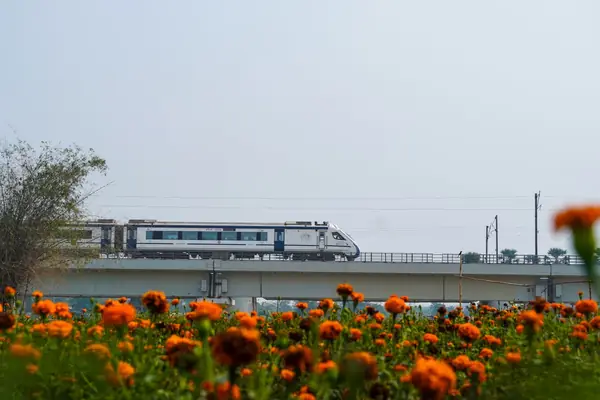
At the time of writing, the Gatimaan Express (12049) and Vande Bharat trainsets on specific upgraded stretches, such as parts of the Delhi-Agra section, are authorised to run at up to 160 km/h. Most Vande Bharat routes, including the Vande Bharat Express (22439) between New Delhi and Katra, are capped lower by the track, typically 110 to 130 km/h. That is currently the practical ceiling for regular passenger service in India. In trial runs rather than passenger service, a Vande Bharat rake has touched speeds as high as 180 km/h on a test section, which is a useful marker of where Indian Railways' rolling stock and track upgrades are headed, but it isn't a speed you'll experience on a normal booking.
| Train type | Top authorised speed | Typical end-to-end average |
|---|---|---|
| Vande Bharat Express | Up to 160 km/h on cleared sections | About 55 to 95 km/h depending on route |
| Gatimaan Express | 160 km/h | Around 110 km/h on the Hazrat Nizamuddin to Agra stretch, lower over the full run to Jhansi |
| Rajdhani / Duronto | Mostly 130 km/h | About 65 to 90 km/h on most long routes |
| Shatabdi | 130 to 150 km/h | About 70 to 90 km/h depending on route |
| Ordinary superfast express | 110 to 130 km/h | 55 to 75 km/h |

Why trains can't run at top speed everywhere
Four things hold average speed down even on India's best trains:
- Track geometry. Curves inherited from decades-old alignments force speed restrictions that new signalling or new trains can't fix without physically rebuilding the track.
- Shared corridors. Most passenger trains run on the same lines as freight and slower passenger services, and timetables have to leave room for that mix.
- Level crossings and populated stretches. Speed limits drop near crossings and through crowded approach zones for safety, regardless of what the train itself is capable of.
- Station halts. Every stop adds acceleration and deceleration time on top of the dwell time at the platform, and a train with more stops loses more of its potential speed to this even if its top speed is high.
Which route has the fastest true average speed
Short, relatively straight, low-stop routes tend to post the best average speeds in India, which is why the Gatimaan Express's Hazrat Nizamuddin to Agra stretch (the train now runs on to Jhansi) and a handful of newer Vande Bharat routes on upgraded track post some of the highest averages in the country, well above what most Rajdhani and Shatabdi trains manage over longer distances with more stops and older infrastructure. Exact figures shift as track upgrades and new Vande Bharat routes roll out, so for the current fastest route by average speed, check each train's own timetable page rather than relying on an older published ranking, since this is one of the fastest-changing corners of Indian Railways right now.

How to use this when picking a train
If your priority is minimum total travel time, compare scheduled durations on the trip planner for your specific route rather than choosing by train category. A Vande Bharat isn't automatically faster than an older Shatabdi on every single route, it depends entirely on the track between your two stations. Check a train's live running status and its recent on-time record too: a train with a fast schedule that regularly runs late isn't actually saving you time in practice.
What's changing the speed picture right now
Indian Railways has been running an ongoing speed-upgrade programme, widely referred to by its Mission Raftaar branding, that targets higher average speeds on trunk routes through better track, signalling and level-crossing elimination rather than just faster trains. As more of that work finishes on a given corridor, average speeds on trains using it rise even without changing the rolling stock at all. This is why a route's average speed today can look noticeably different from what it was even two or three years ago, and why relying on an old comparison chart can be misleading.
New semi-high-speed corridors and additional Vande Bharat routes are also being added regularly, which is the other reason this list keeps shifting. Rather than treating any single published ranking as fixed, treat it as a snapshot, and check the live timetable for the specific train and route you're considering before you book, especially if speed is the main reason you're picking one train over another.
Use it on your trip
Frequently asked questions
Which train currently holds India's top speed record?
A Vande Bharat trainset holds the highest recorded speed in a trial run, at 180 km/h. In regular passenger service, the practical ceiling is 160 km/h, reached by the Gatimaan Express and some Vande Bharat routes on cleared stretches.
How fast do Vande Bharat trains actually run on most routes?
Most Vande Bharat routes average somewhere between about 55 and 95 km/h end to end, well below the 160 km/h top speed, because of curves, shared track and station stops along the way.
Why can't trains run at their maximum design speed everywhere?
Track curves, level crossings, shared corridors with freight and other trains, and station halts all force speed restrictions on parts of almost every route, regardless of what the train itself can technically do.
Which route has the fastest average speed end to end?
Shorter, straighter, fewer-stop routes post the best averages, historically led by the Gatimaan Express's Hazrat Nizamuddin to Agra stretch and newer upgraded Vande Bharat corridors. Check the current timetable for your route since this changes as track upgrades continue.
Sources
Rules and fares change. Check the official source before you travel. Last reviewed 30 September 2026.